




How Can Faith Transform Even Our Enemies?
What power does faith hold when faced with rejection and violence?
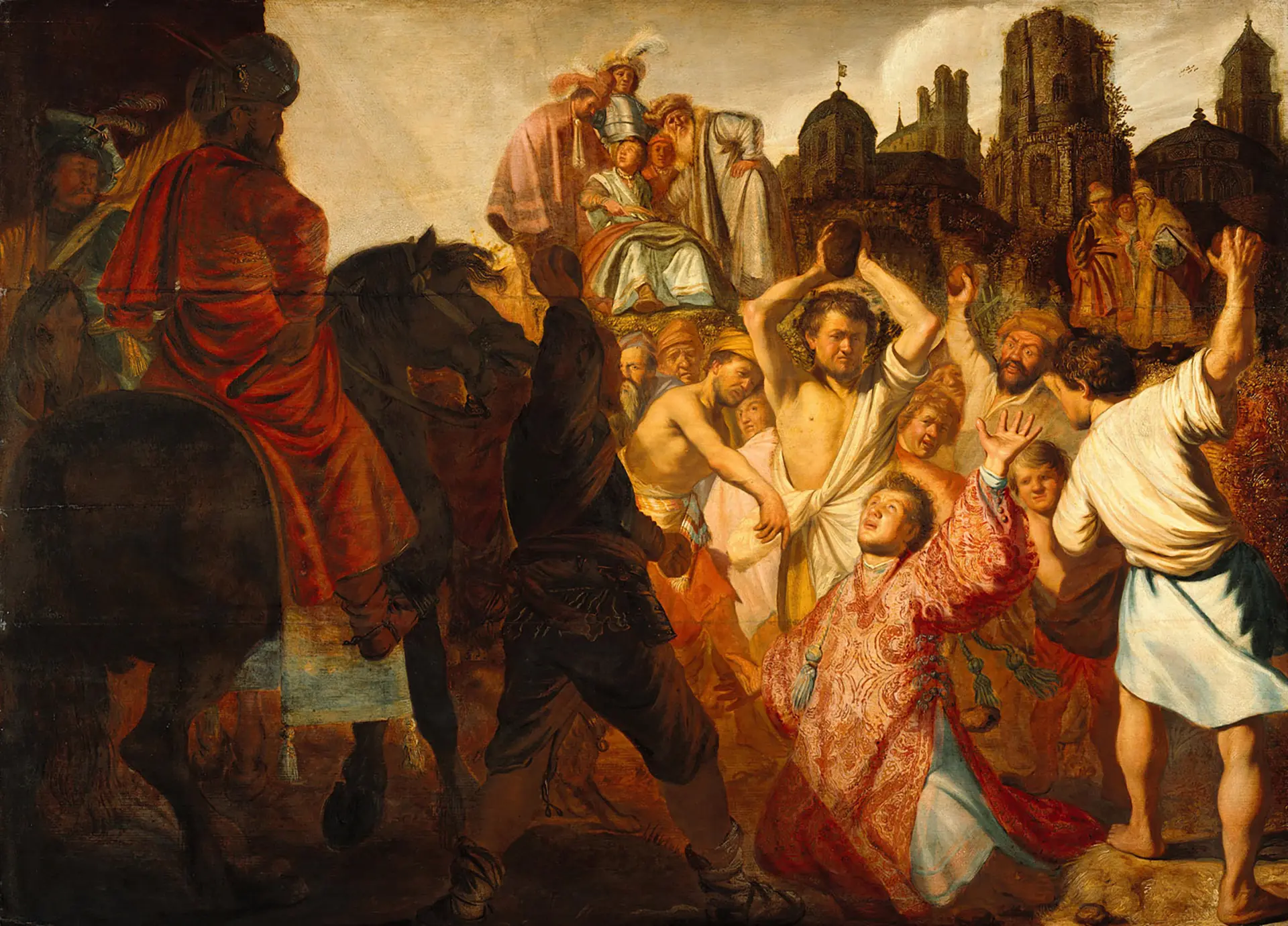
Rembrandt’s earliest known painting, The Stoning of Stephen, was completed in 1625 when he was only 19 years old. The painting brings to life the dramatic biblical account of Stephen—the first Christian martyr—recorded in Acts chapter 7.
Stephen was a deacon who boldly accused the crowd of rejecting and killing the Messiah. His words enraged them, and the people seized him, ready to stone him to death. In the center of the painting, Stephen’s face is illuminated, turned upward with a peaceful gaze fixed on a divine light. Surrounding him is a mob, rocks raised, prepared to carry out the brutal execution. To one side, a man on horseback observes the scene, while in the background the ancient walls and domes of Jerusalem anchor the event in history.
A remarkable detail lies at the back of the crowd: Saul of Tarsus stands holding the coats of those throwing stones. Interestingly, Rembrandt painted Saul’s face with the same features and gaze direction as Stephen’s. This artistic choice likely foreshadows what was to come—Saul, who approved Stephen’s death, would later become Paul, the great missionary who spread the gospel across the world.
Even more striking is what Rembrandt painted above Stephen’s head. If you look closely, you’ll find a subtle self-portrait of the artist himself among the mob. But unlike the angry crowd, Rembrandt’s expression is conflicted and uncertain. It’s as if he’s beginning to question the violence unfolding before him. Observing Stephen’s peaceful countenance and hearing his prayer, “Lord, please do not charge them with this sin” (Acts 7:60), you can imagine Rembrandt’s thoughts:
“Could I have been wrong about this man? What if he is innocent? What if I have misjudged him?”
This internal struggle mirrors the transformation Saul himself experienced—from persecutor to passionate follower of Christ. Rembrandt’s self-insertion suggests a deeper reflection on conscience, mercy, and grace.
What, then, is the message of this powerful painting?
It shows that even in the face of hatred and death, faith can inspire forgiveness and change. From Stephen’s prayer came Saul’s conversion; from Saul’s ministry came the spread of the gospel to the world.
So when you feel misunderstood, rejected, or wrongly accused for your faith, remember Stephen’s words of mercy and courage:
“Lord, please do not charge them with this sin.”
Faith has the power to transform enemies into apostles, hate into grace, and suffering into hope.
| Artist | Rembrandt |
| Production | 1624 |
| Material | Oil in Oak Panel |
| Dimensions | 123.6 cm (Width), 89.5 cm (Height) |
| Exhibit Location | Museum of Fine Arts of Lyon |
| Accession Number | A 2735 |
| Credit Line | |
| Image Credit | Wikimedia Commons |
 Written by Dr. Neale Schofield

 Discover life and faith through art — free email reflections from Dr. Neale Schofield, straight to your inbox.
Subscribe for free
Discover life and faith through art — free email reflections from Dr. Neale Schofield, straight to your inbox.
Subscribe for free
More from the Gallery
How Can Faith Transform Even Our Enemies?