




A Masterpiece of Chaos and Hope
Have you ever felt like your life was being torn apart by a storm you couldn’t control?
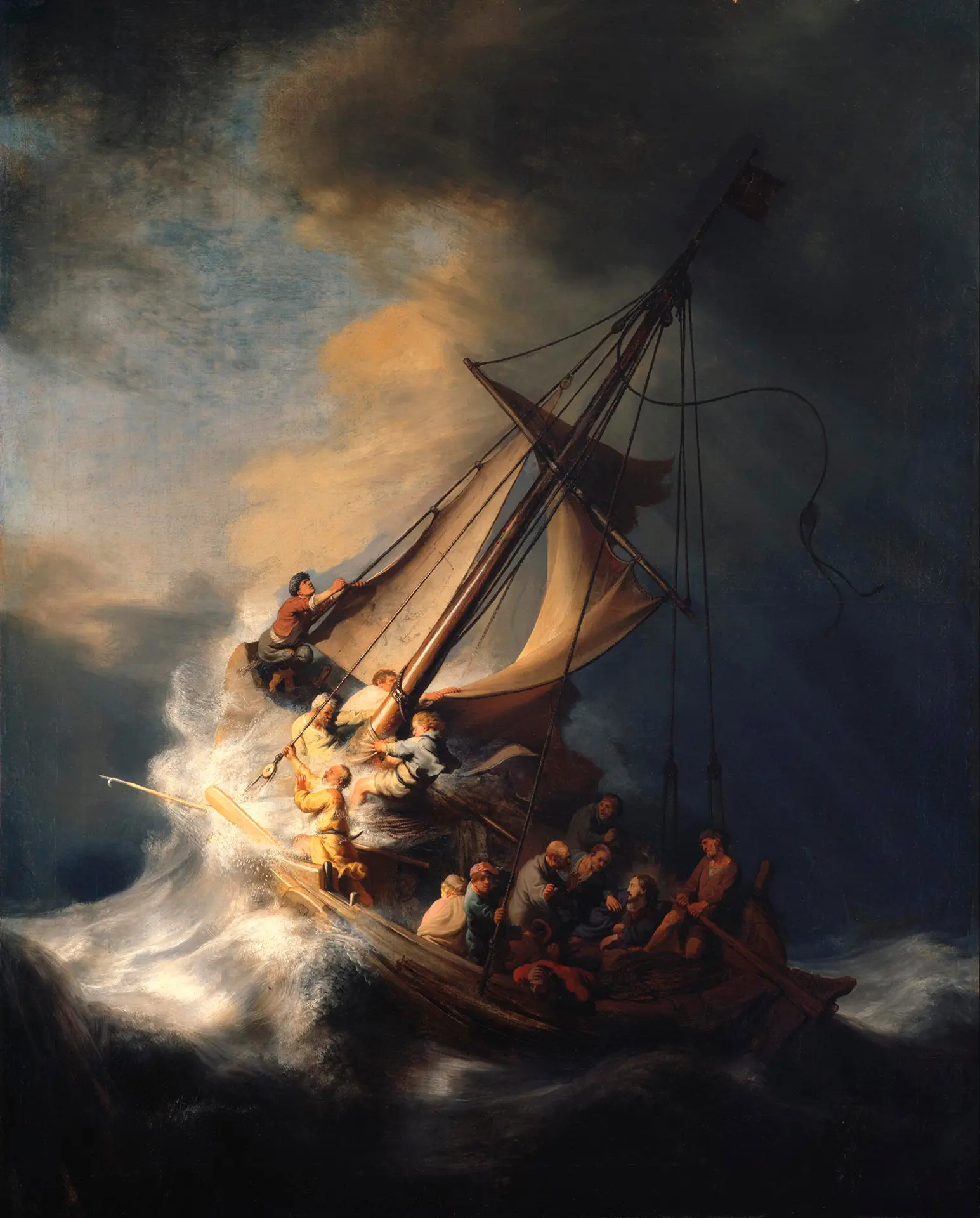
Like you were hanging on by a thread while the waves crashed and the sky darkened above you? That feeling—the helplessness, the fear, the desperation—is exactly what Rembrandt captured in his 1633 painting, The Storm on the Sea of Galilee.
This remarkable work was stolen in 1990 from the Isabella Stewart Gardner Museum in Boston, and to this day, it has never been recovered. All that remains in its place is an empty frame—a silent memorial to a lost masterpiece. But even in its absence, the story it tells still speaks volumes.
Based on the biblical account in the Gospel of Mark, the painting depicts Jesus and his twelve disciples crossing the Sea of Galilee. During the journey, a violent storm suddenly strikes. The disciples panic, the boat is nearly capsizing—and Jesus is asleep at the stern. In their desperation, they wake him.
Rembrandt portrays this chaos with stunning realism. Waves crash. Sails tear. Disciples cling to ropes and rigging. One vomits over the side. But most fascinating of all: Rembrandt painted himself into the scene. He’s the man staring out at us, gripping a rope in one hand and holding his hat with the other. Not part of the original story, he made himself an extra passenger—another soul caught in the storm.
Why would he do that? Why insert himself into this sacred moment?
The answer, perhaps, lies in his personal life. Despite his artistic brilliance, Rembrandt knew suffering. He lost three of his four children, then his wife, then his mother. He eventually went bankrupt. His career soared, then collapsed. Like many of us, he experienced one storm after another. Painting himself into the boat wasn’t just artistic flair—it was a confession. This is me, he was saying. This is my storm, too.
What makes the painting even more powerful is its timing. It doesn’t show the miracle yet. Jesus has just been awakened, but the storm still rages. No one in the boat knows what’s about to happen. But we, the viewers, do.
In the Gospel story, Jesus rises and speaks three simple words: “Peace, be still.” Instantly, the sea grows calm. The wind dies down. And the disciples are left in awe, asking, “Who is this, that even the wind and the waves obey him?”
So, what can this painting—lost though it may be—teach us today?
It reminds us that when life feels out of control, when we’re hanging on for dear life and everything seems dark, we’re not alone. Jesus is in the boat. We may not see the calm yet, but he is already present, already aware, already in control. And in time, he will rise to his feet and speak peace into our storm.
| Artist | Rembrandt |
| Title | The Storm on the Sea of Galilee |
| Production | 1633 |
| Material | Oil on Canvas |
| Dimensions | 128 cm (Width), 160 cm (Height) |
| Exhibit Location | Isabella Stewart Gardner Museum |
| Accession Number | P21s24 |
| Credit Line | |
| Image Credit | Wikimedia Commons |
 Written by Dr. Neale Schofield

 Discover life and faith through art — free email reflections from Dr. Neale Schofield, straight to your inbox.
Subscribe for free
Discover life and faith through art — free email reflections from Dr. Neale Schofield, straight to your inbox.
Subscribe for free
More from the Gallery
A Masterpiece of Chaos and Hope