




The Missing Violin: Caravaggio’s Invitation to Enter the Music
Do we truly understand the power of music in our lives?
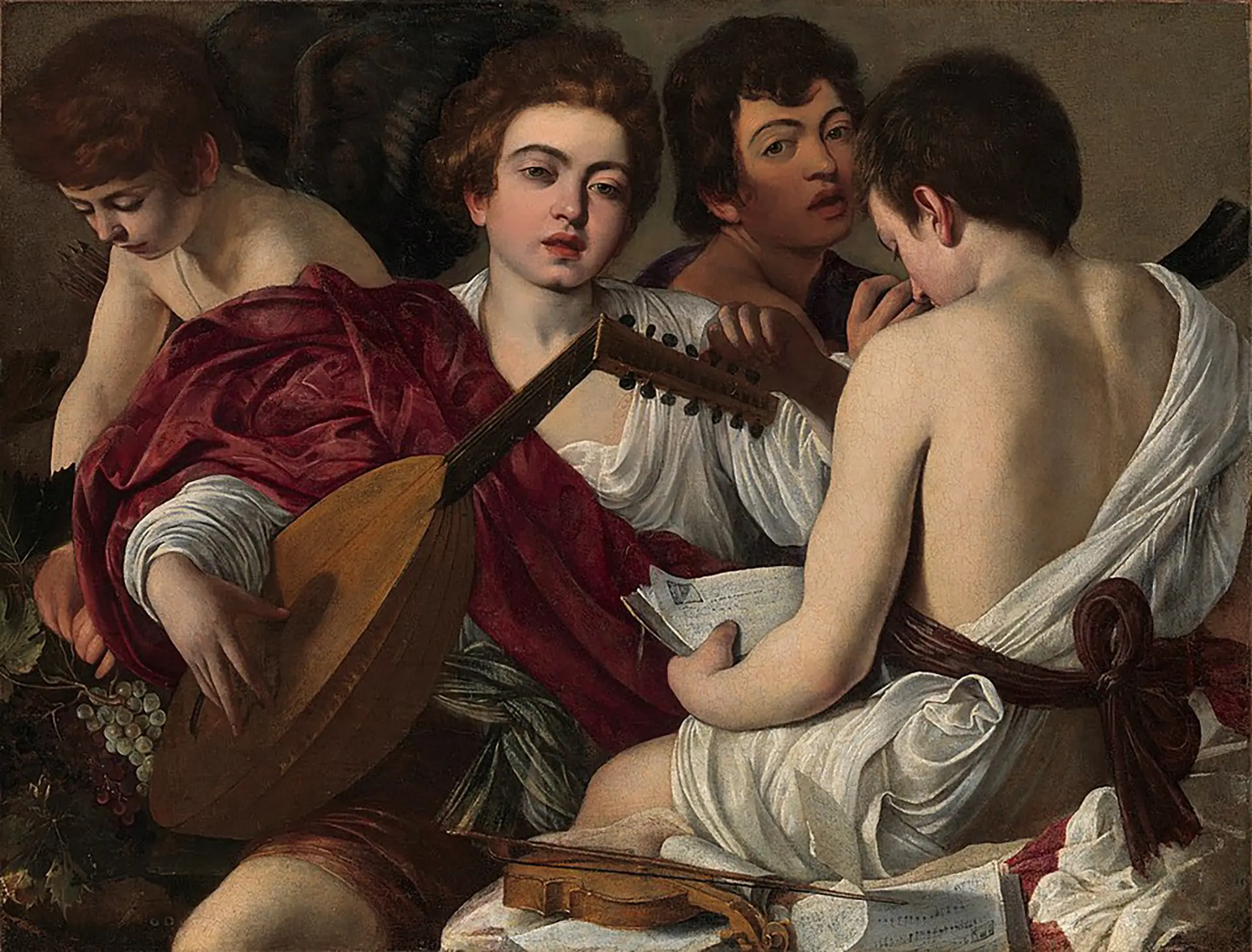
Among Caravaggio’s most celebrated works is The Musicians, a painting rich with allegory, emotion, and symbolism. At first glance, it appears to depict a simple scene of four young men preparing for a musical performance. But a closer look reveals something much deeper.
The painting is an allegory of music and love. The man with his back to us is preparing to sing, his posture angled toward the sheet music before him. Though the notation is difficult to decipher, both tenor and alto lines are present—revealing this is more than just a casual scene.
To the side, a young man in a toga tunes his lute. A vivid red sash wraps across his chest, drawing the viewer’s attention. His expression is striking. Tears glisten in his eyes, hinting at the emotional weight of what he is about to play. He is the emotional center of the painting.
At the rear stands a horn player—none other than Caravaggio himself. He quietly includes his own image, placing himself within the moment, not as an observer, but as one of the musicians. It’s a subtle but personal gesture, revealing how much he identified with the music and its emotional pull.
To the left, Cupid reaches toward a bunch of grapes. His presence points to the symbolic connection between love and music. In classical thought, music was not merely entertainment; it was the language of desire, longing, and the soul. Caravaggio affirms that view.
But perhaps the most powerful detail is the one that seems smallest: the solitary, unplayed violin resting at the front of the scene. No one touches it. No one claims it. And that is exactly the point. The violin is meant for the viewer. It’s an invitation—a silent call to participate. Caravaggio isn’t just showing us music; he’s inviting us into it.
Though this painting was not created for a religious purpose, its message carries spiritual depth. Music has long held a central place in Christian faith and worship. It shapes our emotions, shifts our focus, and draws us closer to God.
The Bible says, “I will sing to the Lord all my life; I will sing praise to my God as long as I live” (Psalm 104:33). Notice the language: we sing to the Lord—not merely about Him. True worship is relational, not performative. In song, we commune with God.
When life is heavy, music can lift our eyes from hardship back to heaven. It aligns our hearts with truth when words alone fall short.
Caravaggio understood this—both as an artist and as a soul searching for meaning. His painting gently asks us to consider:
Do we truly understand the power of music in our lives?
Music, when offered to God, becomes more than sound—it becomes presence, connection, and healing. Maybe it’s time we picked up the violin.
| Artist | Caravaggio |
| Production | 1595 |
| Material | Oil on Canvas |
| Dimensions | 118.4 cm (Width), 92.1 cm (Height) |
| Exhibit Location | Metropolitan Museum of Art |
| Accession Number | 52.81 |
| Credit Line | Rogers Fund, 1952 |
| Image Credit | Wikimedia Commons |
 Written by Dr. Neale Schofield

 Discover life and faith through art — free email reflections from Dr. Neale Schofield, straight to your inbox.
Subscribe for free
Discover life and faith through art — free email reflections from Dr. Neale Schofield, straight to your inbox.
Subscribe for free
More from the Gallery
The Missing Violin: Caravaggio’s Invitation to Enter the Music